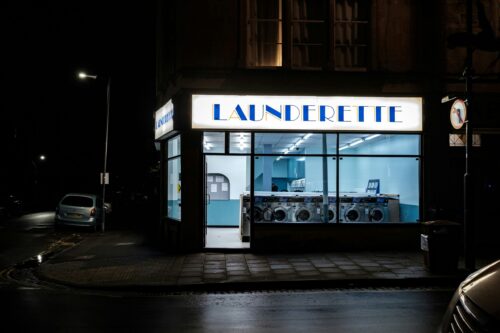

For the past two weeks, I’ve had to use a laundrette. The washing machine I bought only three years ago, from John Lewis, started to make a dreadful grinding noise, as if choking on my towels and Uniqlo knickers. A repairman (such people still exist) decreed that the rear bearing was gone and that replacing the drum unit was uneconomical.
The last time I used a laundrette, I’d sat at a central, communal table writing out Russian verbs. Laundrettes, in my experience, are seedy places, like run-down bus stations with no staff, functional public areas open to all comers and therefore dirty, neglected and a little dangerous. Working on my Russian verbs in early 1990s Melbourne, I’d kept one eye out for feral people seeking warmth or opportunities for petty theft.
(Bus and train stations have greatly improved over the decades and some now resemble shopping malls.)
In this era of cheap washing machines, who needs laundrettes, apart from travellers? An Australian friend was perplexed not to find one in central Edinburgh. To resolve her knicker crisis, late in a long European trip, we went to M&S on Princes St so she could buy some fresh to see her home.
For some reason, Glasgow is better supplied with public laundries. From the mid-nineteenth century to the 1980s, working-class wifeys carted their weekly wash to the local wash house, the steamie, often in a pram. The steamie was a key social node, and some women protested their eventual closure, in the early 1990s.
The Speed Queen on Great Western Road is aggressively shiny and efficient, tangerine and chrome. Compared to a steamie, it’s the laundry equivalent of a space ship. Perhaps it’s just new and needs more time to be broken in/down by public usage. It has a retro American flavour, from the era when the combined affluence and tackiness of American culture—massive cars, fifty flavours of ice cream, trashy Technicolour movies, double-door fridges with ‘ice water’ dispensers—was both foreign and alluring to a postwar Europe still living on rations in bomb-cratered cities, nursing bruised memories of past civilisational glory.
On my first Sunday expedition, there was only one other person in the Speed Queen, a black woman a little younger that me, wearing a long, baggy check shirt and a turban-style hat. She was reading a library book.
To repeat: she was reading a book, not scrolling.
I needed a small machine. There was two. One was in use. The other one had completed its cycle but was still fully loaded. According to the instructions, printed in large tangerine letters on a white plastic notice board, laundry not removed within ten minutes of completion could be taken out by the next person.
The turbaned woman confirmed that the machine had been sitting idle since she came in. I was in the clear.
There was no bag on top of the machine. I’d have to lump the wet clothes into a damp, undignified pile. I began imagining the reaction of the owner, who would surely come in as soon as I’d done the deed. Some street-tough lass or tobacco and booze-cured harridan who’d scream abuse and even mete out violence to a middle-aged woman for touching my effing stuff. Or maybe a spoiled rich student who’d tossed in her load and gone off for a long avocado toast brunch with her pals, oblivious to the laundry needs of other people but highly protective of her smalls.
The Speed Queen app alerts you when your cycle is done, so there’s no excuse, even for young people.
(I did not think for a moment that it was a man’s laundry. A man probably wouldn’t care if someone dumped his finished laundry on the top of the machine.)
I was caught between my own timidity and my annoyance at such lack of consideration. Treating public space like private space—parking illegally, playing loud music in a park—is a form of entitlement, and there’s a lot of it about. The entitlement of the rich is not the same as the assertion (or substance-based oblivion) of the downtrodden, whose public misbehaviour is more severely punished. A certain kind of person regards parking tickets or speeding fines as a personal affront. They often drive very expensive cars. (Caveat: I am less likely to notice illegal parking by low-end vehicles.) Notions of shared public space and the communal good went out with communism, where their existence, in the end, was rhetorical.
I’m temperamentally unassertive. Even minor conflict makes me sick to the stomach. Giving in makes me seethe, also not good for the stomach. In my early 20s, I bailed out of flat sharing and went solo, at crushing expense, paying the housing ‘single supplement’. But oh, the relief of coming home to silence, order and the food I’d only just bought the previous day, still uneaten, in the fridge. The rise of single-person households is seen as a social and environmental evil, but for those who choose it over the alternatives, it’s joyous liberation. Flat-sharing renders what should be private space effectively public.
A normal cycle in Speed Queen takes 30 minutes. What were the odds of this hypothetical angry person barging in and screaming at me before my cycle completed and I could get away safely? I’m not a gambler or a statistician. The CCTV cameras offered no real-time protection.
I chickened out and spent an extra £3.50—the price of a West End coffee—on a medium-sized machine. A small price to pay for peace of mind, but I was resentful all the same. I spent the next 30 mins vindictively plotting to empty the small machine on my way out.
(I did not. Pass-agg behaviour is demeaning. Also, I’m a grown up.)
Another woman came in, weekend-scruffy, carrying a large IKEA bag in Pride stripes. Unloading her wash into the other medium machine, she sat down on a moulded tangerine chair and opened a book.
Three middle-aged women, reading books. Maybe the ruffians of Glasgow were too hungover after the big Celtic win to do any Sunday-morning laundry. Their victory had required a significant polis presence in Trongate the previous evening.
I’d brought a library copy Helen De Witt’s The Last Samurai, having read about the hoo-hah around the rejected grant, but I couldn’t engage and defaulted to scrolling. The small machine was still unemptied when I left. When would it be claimed? Did some other, braver, soul empty the machine for their own use? I will never know.
The next Sunday, I went in mentally and practically prepared for the challenge of someone else’s completed load. I’d brought a large bin liner so that any obstructive laundry could be unloaded more neatly, softening the insult. Arguably, a rubbish bag was an undiplomatic and possibly provoking receptacle, but I wasn’t going to waste a £3 Bag for Life decorated with elephants and zebras on an inconsiderate stranger.
The Speed Queen was busy, but the machine I wanted was free. There was no friction, no stress. Two young women turned up just as two machines completed and reloaded the laundry into the dryers. Nobody spoke or even smiled to anyone else. This was not a steamie experience. In this public space, people went quietly about their business, ignoring everyone else.
An older couple came in and loaded up a machine. From the way they wandered from the machine to the payment machine and back, I could tell they weren’t getting it, even with the instructions in large tangerine font and the streamlined user interface, no doubt tested on consumer focus groups for minimum friction. My instinct was to help, but I was reluctant to interfere and break the Speed Queen code of silence. Eventually the woman caught my eye, a look of pleading helplessness. I jumped up and got their machine working. The woman thanked me. The man followed her out.
This week, I will take delivery of a new washing machine and revert to private laundry. This machine is exactly the same make as the last one, because it’s the only kind narrow enough to fit the dedicated slot. Will it last longer than three years this time around? I didn’t mind my Sunday outings to Speed Queen as much as I expected, but I certainly hope it will.
If you enjoyed this post and would like a heads-up next time I publish, please sign up for my newsletter.
Photo by Oli Woodman on Unsplash.