
Getting a bike for Christmas in the mid-1970s was a big deal. Mine was a girl’s bike, with small wheels and step-through frame. Some girl’s bikes were pink, with appropriately coloured streamers issuing from the end of each handle. I wasn’t a high femme girl and my bike was light blue. My brother had a yellow easy rider with a long banana seat. I rode around the quiet surrounding streets, to the local milk bar to buy sweets or around to a friend’s place.
Adults did not, in general, ride bikes. One of my mother’s colleagues at the library distinguished herself by not having a car and getting around on a granny bike. My mother regarded her carlessness as wilful and even ‘selfish’, because other people had to give her lifts. To compound her oddity, this woman was a vegetarian AND a feminist, defined by my mother as ‘ugly women who don’t wear makeup and can’t get a man’.
(I was a feminist before I’d even encountered the word.)
Most roads in my town were not sealed to the kerb. A narrow strip of bitumen, ragged at the edges, sat on a wide strip of gravelly dirt. Any bike rider who presumed to occupy the bitumen would’ve been beeped and even nudged into the dust. Regional Australia was the land of the car, and at the top of the motorised hierarchy were throaty V8s, driven by men who considered the road their sovereign territory.
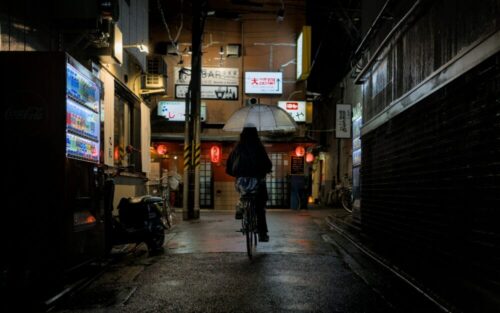
In Japan in the early to mid-1990s, I became a bike rider. Bikes were basic; they had a small frame lock that disabled the back wheel. The flat key fit into your pocket or purse. No need for a heavy D-lock, helmet or hi-vis gear. You wore normal clothes and hopped on and off your bike, as easy as getting on and off a bus.
Outside every Japanese station was a vast tangle of parked bikes, many of them abandoned. These bikes were largely identical; finding your own amid the junkyard confusion depended on recognising tiny differences, like a mother distinguishing between twins. On rainy days, people carried umbrellas and rode one-handed. As well as loading up my basket, I hung bags of shopping off the handlebars. Sometimes I could hardly steer. I was an accident that never happened.
(Sidenote: the Japanese police are now cracking down on umbrella cyclists, along with using a smart phone or wearing headphones while riding, standard behaviour for most of the population. I have to wonder at their spare capacity.)
Back in Australia, I rode around Canberra. I acquired an ugly yellow hard-shell helmet and a heavy, twisty lock. Going out on the bike now involved equipment, to counter the risk of, first, theft, and second, injury, brain damage or death. For a physically timid person, this was not encouraging.
After Canberra, I didn’t get on a bike for 25 years. Living mostly in cities, I walked or used public transport. The suicidal presumption that pushbikes had equal rights to the road was for other, braver people. Selfishly, I valued my life over the survival of the planet.
My former partner had four bikes: a customised Brompton, a road bike, a hybrid and an e-bike. My lack of wheels was deemed an obstacle to shared activity. During COVID, we went to a bike charity to resolve my inadequacy. Under the tutelage of a very tall Dutchman, I chose a small, slightly rusty ladies’ Raleigh Tundra for £150. Like many serious bike folk, he was evangelical about his chosen mode of transport. As a hard-headed Dutchman, he scoffed at helmets. But I bought one anyway.
My disinclination to take my rightful place on the road alongside cars was a further obstacle to shared activity. Even on bike paths, I rode too slowly or nervously, or stopped too suddenly, or was irritating and inadequate in other ways. I was simply not a serious cyclist. The COVID bike embodied the failure of active togetherness.
When I moved to Glasgow, I won the Cyclehoop lottery. These small, metal Nissen huts house six bikes on a single parking space. (Sidenote: the combined rent of six bikes, at £72 each, is significantly higher than one residential parking permit, ranging from £80 to 220 depending on CO2 emissions. No wonder councils love them.) Cyclehoop slots are few and far between, but I got one across the road from my flat. It was ordained: I was to be an earth-saving cycle commuter, once I worked out how to navigate Glasgow’s discontinuous cycle paths and ‘quiet routes’.
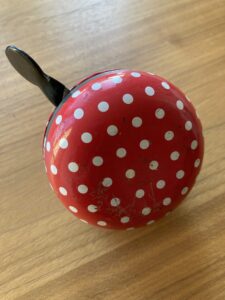
I took unofficial mornings off work to join group rides led by another bike charity, and then graduated to a women’s cycling club run by serious cyclists with proper expensive bikes. On my charity bike, with its mismatched mudguards, rust-flecked frame and large, loud, red polka-dotted novelty bell, I obviously wasn’t a serious cyclist myself.
I saw far-flung and fringe parts of Glasgow I’d never been: Lambhill, Rutherglen, Robroyston, Drumchapel, out east along the Clyde Path. I rode the little Yoker ferry, now closed, across the river. I experienced the assertive thrill of riding, briefly, on a busy road amid a pod of cyclists, passed at close quarters by aggressive motorists, often male.
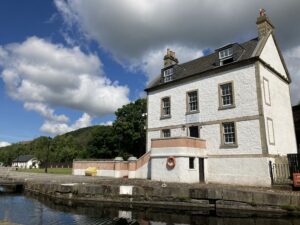
My last ride with the club was all the way to Bowling, on the Clyde. It was a beautiful July morning, spirit-lifting and life-affirming, and I felt strangely tired. A few days later, I received my cancer diagnosis.
The COVID bike sat gathering cobwebs in its Nissen hut over winter while I healed. I took it for a service the following spring and renewed my club membership, but I never had the time or energy for a ride. Neither did I use the bike for basic commuting: it was less hassle to walk or catch the subway. And the weather, in Glasgow, is often cold or wet or both. I see cyclists pumping through the rain in their hi-vis waterproofs, and I admire them, but I have no wish to emulate their sturdy independence.
Meanwhile, Glasgow’s cycle lanes expand, to the outrage of motorists and retailers on major streets. I have been personally informed that taxi drivers and driving instructors loathe them. A newspaper headline described the current carve-up on Byres Rd, the high street of Glasgow’s West End, as a ‘middle-class camino’ (paywall). Cycling is viewed as yet another moralistic imposition by the Waitrose elite (apart from the Telegraph-reading, Jeremy Clarkson faction).
As another year’s rent on my Cyclehoop fell due, along with my club membership, I decided to offload my COVID bike, along with the constant sense of guilt, both for not cycling and for denying an active, serious cyclist a precious Cyclehoop slot.
I’ve kept the loud novelty bell, along with my helmet, lock, hi-vis jacket and other bike paraphernalia, filed away for a future life. In different circumstances, in a world with a fully joined-up car-free cycle network and better weather, I’d be a cyclist, part of the planet-saving middle-class camino, but not here, not now.
If you enjoyed this post and would like a heads-up next time I publish, please sign up for my newsletter.