
Seasonal thoughts on shopping
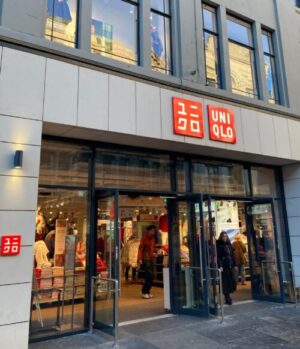
And lo: Uniqlo has finally come to me! After years of having to go to London, Tokyo or Singapore to buy HeatTech tops, non-trendy jeans and infinitely stretchy trousers, I can now go to the slightly less nasty part of Argyle St in central Glasgow. I don’t even remember what was there before—Ann Summers, a tartan tat shop selling polyester kilts and joke tam-o’-shanters with red hair attached? A vape shop? These have taken over from phone boxes as an inevitable presence on British high streets.
I have a history with Uniqlo (‘Unique Clothing’, in the uniquely Japanese way of compressing English). In the mid-1990s, as a foreign student in Japan, I faced the clothing problem. Not only were Japanese women’s clothes aesthetically alien to me—the lifeless pastel colours and cutesy trim—but nothing fit. Although I’m short, at 57kg I was large by Japanese standards.
A tall Estonian man introduced me to Uniqlo, a warehouse-type shop on the outskirts of town. The clothes were plain, functional and neutral. It was like an IKEA for clothes. I bought a men’s M-size parka. Being in Japan had already desexed me, so having to buy men’s clothes was an auxiliary humiliation.
My skinny Estonian friend was in the multiple-X L range.
Sidenote: our status as ‘aliens’ was further confirmed by the mandatory health check for government-funded foreign students and researchers. Everyone but the Koreans and Chinese were judged overweight or obese by Japanese standards. An Englishwoman who was, by Western standards, very large, ran out of the nurse’s room in tears after being told she was ‘off the scale’.
When Uniqlo landed in London in the early 2000s, I was jubilant, and also a little smug, because I was already in on it. Japan wasn’t yet trendy, but the wave was building.
I did wonder about the sizing. Western women would not take kindly to being XXXXL. Yes, there has been an adjustment. These days, I’m a S or M. Sizes have changed in Japan too. I’m now an M-size woman rather than an L, although in Tokyo I had to buy L-size in a bra-top summer dress. For a hilarious consumer moment, I was ‘big busted’.
A Japanese friend boycotts Uniqlo because the parent company, Fast Retailing, is unethical. In the moral swamp of capitalism, there are many ways in which a company can fail to measure up: treatment of workers, environmental impact, long supply lines snaking into dodgy regimes, corporate transparency (an oxymoron). Uniqlo isn’t the worst of the worst (Shein?), but it’s not unproblematic.
Capitalism is inherently dodgy, being founded on exploitation. Marx told us this. The desire of consumers to evade any moral responsibility has resulted in a whole greenwashing PR industry, the Modern Slavery Statements, the corporate codes of conduct, the sustainability certifications. As a consumer who simply needs a t-shirt or a pair of jeans at a reasonable price, you have to take this on trust. And most people do. Unless you have a sheep, a spinning wheel, a handloom and a sewing machine at home, your options are limited.
I’ve done my research on ‘ethical alternatives’. Thirty-five quid or so for a sustainable plain t-shirt may be the ‘right’ price, but I paid £7.99 a pop at H&M for my last batch. The sizing is highly variable, but I get years out of them.
In my secular quest to be a good person, I don’t buy books from Amazon. I use the Ethical Alternative link, Bookshop.org, BetterWorldBooks or Blackwell’s. This minor effort on my part has had no discernible effect on Amazon’s profit or market position, but for a few clicks, I feel like a better person.
For stuff, odds and ends (gym gloves, pot lid rests, earplugs, sticky yellow Ninja gnat traps), the kind of things you used to buy at a big Woolworths, I default to Amazon. Bits and pieces I wouldn’t know where to buy on the diminished British high street. Oh I miss Woolworths. (Big W and Kmart live on in Australia, in suburban and regional ‘retail centres’ with massive car parks.) If I have a choice, I’ll buy from a specialised online shop, but sometimes Amazon simply has the stuff and it already has my details. I am as morally compromised as most other people. In my own subatomic way, I contributed to Katy Perry being fired, briefly, into space.
A bicycle-riding, right-on acquaintance in my Sheffield days was in-my-face horrified about my Amazon usage. The era of high sanctimony was only just beginning, and I wasn’t used to being judged so baldly. He was also horrified that I’d paid £5 for a (large) loaf of organic artisan sourdough bread from a wholefood coop. Why didn’t I make my own? Er, for the same reason I don’t weave my own t-shirts or knit my own underwear. Because, as Adam Smith pointed out back in the 18th century, specialisation is simply more efficient. BECAUSE I DON’T KNOW HOW, I DON’T HAVE THE TIME, AND I CAN’T BE ARSED.
(During lockdown, I continued in my normal employment, at home. I was thus denied the opportunity to learn how to make bread or sew my own clothes.)
By other measures, I’m on the moral high ground, sort of. It’s cheaper to fly to London from another British city than catch the train, but I always get the train. I hate airports, and in the time it takes me to get to Glasgow airport by public transport I could be across the national border and in Carlisle (caveat: if the Avanti west coast train is running properly). I don’t have a car, but I can’t justify the cost and I’m scared of driving. My ethical superiority is circumstantial; I have not suffered significantly to achieve it. Does it still count?
I fly to Australia once a year: the moral cost of having an elderly parent on the far side of the world. This probably writes off the moral credit of not having a car.
I recycle, a basic urban religion, but that’s a scratch in the dusty earth. Do the bin men care that the nice lady in the top floor flat rinses out her yogurt cartons? Which possibly shouldn’t be in recycling anyway, because they’re not the right sort of plastic. I take on trust that the cash-strapped council doesn’t simply offload the responsibility to a dodgy contractor who ships it out to a poor country. Life in a complex modern society is based on wobbly sequences of unverifiable promises.
People queued for the opening of the Glasgow Uniqlo in October. I don’t believe in queuing. My mother says I once proclaimed that I wouldn’t queue for a ride in the Tardis. I have no memory of saying this, but it’s the sort of thing I would say.
I went in a few weeks later, a recce mission. The layout was confusing; the rapacious, shoving crowds, discombobulating. I noted the walls and shelves of Heat Tech, the piles of jeans and cigarette-leg trousers, the ‘ultra-light’ down jackets and ‘bra tops’ for women with minimal boobage. The odd pastel colours and the designer ‘collabos’. I didn’t need anything, not even a fresh white Supima t-shirt, but this familiar superabundance was reassuring.
As far as I know, the CEO of Fast Retailing, Yanai Tadashi, has not fired his wife and her besties into space.
If you enjoyed this post and would like a heads-up next time I publish, please sign up for my newsletter.